
Novel (earlier)
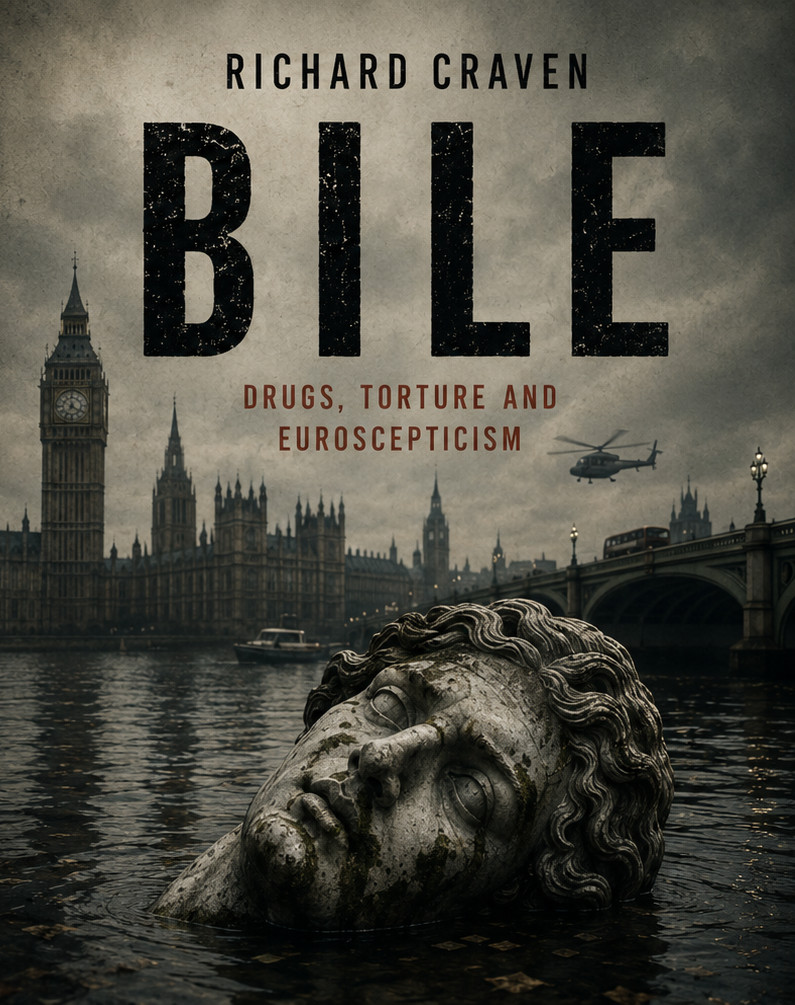
Bile
Drugs, Torture and Europscepticism
His first novel, written in the 1990s under the name Mark Brand: coarse political satire and speculative fiction, with questions of identity, persistence and personhood.
Buy the paperback Buy for Kindle
Overview
Introduction by Richard Craven
I began writing Bile in the Summer of 1996, shortly after completing my Philosophy BA at UCL. I was in my early 30’s and it was my first novel. Despite its relatively short length it took more than two years, mainly because we had two small children by then and I took a moderately active share in parenting them.
Thirty years ago it was still possible for White male authors to get their work into print, and Bile was duly published in 1998, albeit by some vanity shysters posing as cooperative publishers. I wrote it with my characteristic niaiserie de jeunesse under the pen name Mark Brand which, to state the painfully obvious, was a somewhat impoverished joke about trade marks and brand names. Shortly after its publication we left London and moved to Gloucestershire, and Bile sold a few hundred copies in Cotswold bookshops and elsewhere before duly sinking without trace.
Read the whole introduction
I re-read Bile for the first time in thirty years shortly before sitting down to write this introduction, and was fully expecting to be appalled and embarrassed by the scatological juvenility festering between its covers. It took two or three days, and suffice to say that my expectations were met - it is nothing if not a young man’s novel, and relentlessly crosses the line into outright obscenity.
Bile’s surface plot relates the hunt by competing agencies following the UK’s military defeat and conquest for the History Bug, a prototype machine enabling the capture of historic audiowaves including speech. During the rereading process, I began to realize that beneath this crusty and malodorous superstratum lurks a novel about identity, a portrayal of fracturing nationhood mirrored by the disintegration at the individual level of language, thought, personal identity, and personhood altogether.
Bile’s language represents these atomising tendencies, both in its uncompromising obscenity and in the fact that it is quite literally written in a different language: Estuarine, the phonetic rendering of the South-Eastern English dialect of the 1990’s, is at once instantly recognizable and at the same time, especially to the contemporary ear attuned to latterly evolved ideolects like Jafakan, utterly foreign - I habitually disparage it as the ‘bastard son of Cockney’.
Secondly, there is the complexity. Bile is at root a coarse Juvenalian satire of the political landscape of the mid-1990’s, a time when, as the European Union transformed itself from a free trade zone into an entity with the trappings of a superstate not to say an imperium, the UK found itself engulfed in an increasingly rancorous dispute both internal and external about its role in the new dispensation, and most especially about its continued existence as a sovereign nation.
The Bilean satire of this epoch is quasi-science-fictive insofar as it is set fifteen minutes into the 1990’s-relative future, during the insanely violent aftermath of a military invasion of the UK by the EU, as competing satrapies, secret service agencies, football hooligans, businessmen, spa cure therapists and a gimp motorcycle parcel delivery service fight over the scraps of the rotting British cadaver politic; not for nothing did I give Bile the strapline “drugs, torture and Euroscepticism”. But this is only the surface. Beneath its crusty and malodorous skin, Bile conceals a philosophical meditation on identity and persistence. This calls for a diversion into the philosophical landscape, which I will endeavour to make as brief as possible.
When we consider how objects and individuals persist through time and change, our default position, the ordinary intuitive commonsensical view, is that a given object or individual s is a three-dimensional entity wholly present at each moment of its existence. For example, the I who walked across the Bristol Suspension Bridge this morning and the I presently sitting in my living room writing this introduction are intuitively one and the same. That is to say, in the language of the philosophy of identity and persistence, s endures.
The immediate objection to the endurance account - and what gives the philosophy of persistence its savour - arises from its confrontation with the deliverances of Leibniz’s Law of the Indiscernibility of Identicals, namely that for any pair of objects/individuals x and y to be identical, they must share all their properties P in common - formally: ∀x∀y (x = y → ∀P (Px ⇿ Py)). But with the passage of time objects change, that is to say they acquire and lose properties. How, then, can Monday’s ripe yellow banana be one and the same object as Friday’s rotting black banana?
The endurance account’s problem with identity through change and time is famously illustrated by - we might very well say crystallised in - an extreme case, viz. the parable of Theseus’s ship, which as time progresses has all its planks replaced. How can the ship at the initial time t1 be one and the same object as the ship at the later time t2, given that the t1 ship and the t2 ship are ex hypothesi composed of completely distinct constituent parts?
The two best known responses to Endurantism’s Leibnizian travails are Perdurantism (Lewis) and Stage Theory (Sider, Hawley). Lewisian Perdurantism treats objects as four-dimensional “worms”, that is to say in terms of the three spatial dimensions plus time. What the perceiver observes at a given moment is the momentary time-slice of the worm object. Perdurantism’s location of identity at the four-dimensional level resolves the Leibnizian problem. The worm-banana is the same worm-banana all the way through; only its time-slices are non-identical with each other. That one time-slice is green, while another is yellow and a third is brown doesn’t matter. But this solution comes at the cost of the commonsense intuition captured by Endurantism, that what we see from moment to moment is the whole object.
Stage Theory aspires to resolve the impasse by locating identity at the three-dimensional level per endurantism, with however a background four-dimensional ontology per perdurantism, with the individual stages of the given four-dimensional entity related to one another by e.g. counterpart relations explicitly adapted from the counterpart relation used by David Lewis to ground his possible-world account of modality. The principal criticism of stage theory is of course that it is merely a verbal variant of perdurantism, failing to capture the intuition that ordinary objects, wholly present at each moment of their existence, persist through time and change.
Modulo the foregoing criticism, an influential variant of Stage Theory, salient to present considerations, is that of Derek Parfit’s account of personal identity. Parfitt bites the bullet with regard to the Leibnizian problem: identity between the stages of a person is not what matters. What matters is connectedness, if not necessarily of body than at least psychological. Parfit calls this relation of connectedness variously Relation R or q-identity, the latter reflecting the fact that in the normal course of things ordinarily language usage takes the succeeding stages of a person to be identical.
And so begins the segue back to my own work. Some years after Bile’s publication I undertook a Philosophy MA at Bristol University, which as mentioned in the related footnote featured a somewhat radically reductionist Heraclitean thesis on persistence. To Heraclitus is attributed the famous dictum, put by Plato into the mouth of the radical Heraclitean Cratylus, “You cannot twice step into the same river.” Extrapolating from this dictum, the ontology of objecthood, and by extension of personhood, is subordinated entirely to one of process. If Parfitian Stage Theory bites the bullet, Heracliteanism chews it to a pulp and spits it out. No respect whatsoever is entertained for the intuition that objects persist, let alone change through time. They are merely fleeting configurations of matter-energy in a universe of eternal flux. If this is drastic for objects, it is catastrophic for personhood. How can a person with merely instantaneous existence complete a thought, experience a sensation, feel an emotion?
This shocking picture was adumbrated in Bile, with its disintegration of institutions, fracturing of language and atomisation of individuality. The embodiments thereof are several: the rampant torture, the drug epistemology, the dreadlocked technohead canal-side penis-drummers assailing Merkin and Merlin on their canal jaunt towards London, the rump secret service resistance’s purity-spiral suicide by salmonella as the Anti-Hygiene Underground, the football hooligan militias cavorting in their bridal gowns. Undoubtedly the starkest representation is Gimp Couriers, a fleet or perhaps hive of motorcycle despatch riders pressganged by a Cockney businessman rejoicing in the moniker Jacuzzi Hound, whose gimp-suited denizens exchange by some completely unspoken process their callsign numbers, gimpsuits, postures, gaits, accents, temperaments, roles, prior histories, identities and ultimately even body parts. Even Grey, the grey-gimpsuited Ohwun at the still point of this turning circle who struggles to retain some shreds of his identity and humanity, is not immune. The final revelation, viewed from his perspective, completes the disintegration.
Reviewed in
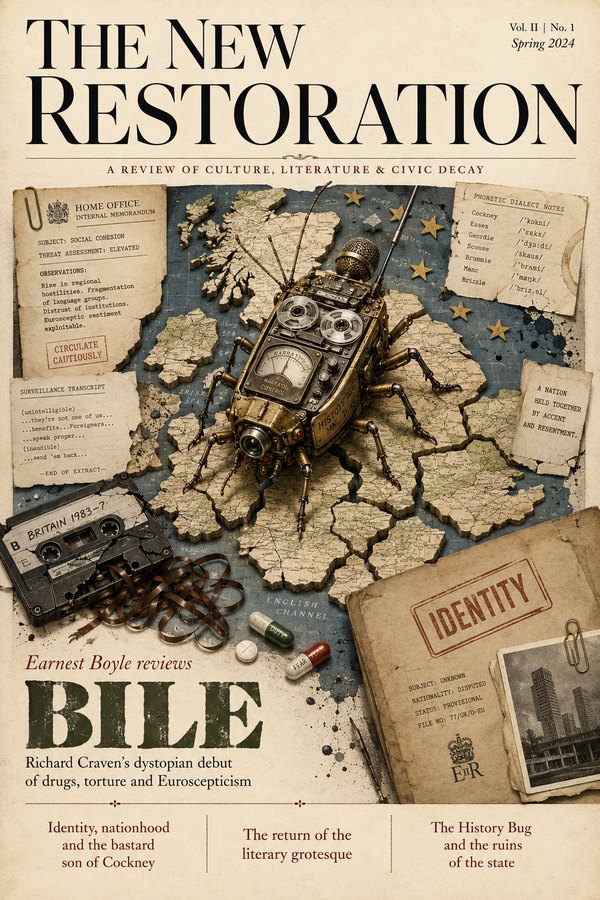 The New Restoration
Review by Earnest Boyle
There are novels one admires, novels one enjoys, and novels one rather wishes had not been written at all.Read the review →