
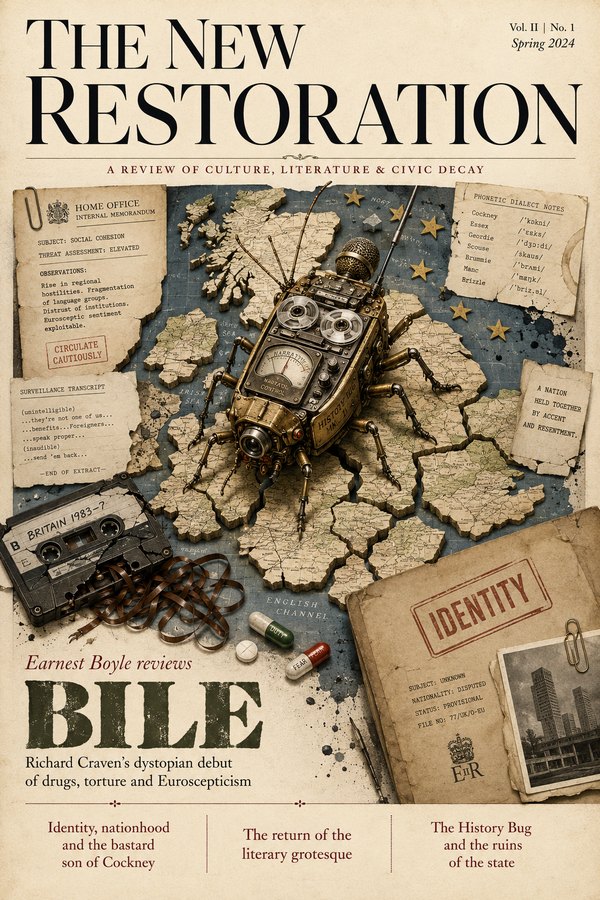
Bile Reviewed by Earnest Boyle in The New Restoration
A review of Bile
Earnest Boyle, Senior Literary Correspondent, The New Restoration
There are novels one admires, novels one enjoys, and novels one rather wishes had not been written at all. Richard Craven’s BILE belongs squarely to the last category, which is precisely why it demands serious attention.
First published under the pseudonym Mark Brand in the late 1990s and now disgracefully exhumed for republication, BILE is a work of extraordinary vulgarity. It is saturated with obscenity, bodily degradation, sexual grotesquerie, political hysteria and enough ideological hostility to the late twentieth-century liberal settlement to induce immediate cardiac distress in a modern publishing intern. One suspects several sensitivity readers may already have required counselling.
And yet.
Beneath the foul-mouthed delirium and estuarine verbal sewage there lurks a genuinely formidable intelligence. Craven is not merely trying to shock the bourgeoisie; he is trying to dismantle the assumptions upon which bourgeois civilisation rests. The collapse depicted in BILE is not simply political.
It would be comforting to dismiss the book as a period-piece of Eurosceptic agitation, a sulphurous dispatch from that now half-forgotten age when Maastricht, subsidiarity and the Charter of Fundamental Rights could still make Englishmen foam at the mouth. But BILE will not quite permit so easy a disposal. Its Europe is too demented to be journalism, its Britain too diseased to be a mere patriotic lament. The politics are certainly there, and they are frequently deranged; but they serve a larger disintegration.
Britain has not merely lost sovereignty in some absurd quasi-European future war. The nation’s institutions, memory, continuity and even metaphysical coherence have begun actively to liquefy.
The result resembles a collaboration between Anthony Burgess, Jonathan Swift and a chemically compromised doctoral candidate in metaphysics trapped overnight inside a Croydon motorcycle dispatch depot.
The central conceit, the “History Bug”, a machine capable of recovering the voices of the past, initially appears a species of cyberpunk MacGuffin. In reality it becomes the philosophical centre of the novel. What survives through time? What constitutes identity? What persists when the ordinary markers by which persons and peoples recognise themselves begin to fail? These questions haunt the book with surprising seriousness.
Indeed, the deepest horror of BILE is not its torture scenes, gimpsuited courier cults, post-national militias or canal-side techno-savages. It is the suspicion that the self may not substantially exist at all.
Craven’s Britain is a civilisation experiencing ontological decomposition.
A civilised novel, one feels, ought in some degree to restore proportion: to show that even amid corruption there remain forms, loyalties, limits, inheritances. BILE does nothing of the kind. It shows the forms themselves collapsing, loyalties becoming unstable, inheritance reduced to residue. That this may be its point does not make the experience more agreeable.
It is unmistakably a first novel, though not in the usual dispiriting sense. There is no hesitancy here, no apprentice’s wish to be liked. Rather, BILE suffers from the youthful vice of wanting to contain everything at once: political nightmare, metaphysical treatise, obscene picaresque, speculative satire, anti-European fantasia, and a joke of such persevering indecency that one begins to admire it against one’s better judgement. The later Craven, I am told, would refine some of these impulses into a more elaborate grotesque architecture. The younger man simply detonates them.
Needless to say, this is not a comfortable reading experience. The prose often resembles a pub brawl taking place inside a philosophy seminar. There are moments when one wishes fervently for the return of clear syntax, moral hygiene and perhaps hanging.
But the novel possesses that increasingly rare quality in contemporary fiction: danger. One senses throughout that the author believes ideas matter, that nations matter, that continuity between past and present may prove catastrophic to lose, both politically and spiritually.
Modern literary fiction, with its therapeutic narcissism and bureaucratically approved emotional palettes, has almost entirely lost the ability to produce works of this scale of derangement.
BILE is frequently repellent, occasionally unreadable and morally indefensible in at least six different directions.
It is also, unfortunately, difficult to forget.