
Helix Folt, the Conservative Reviewed by Crispin de Phalluster in The Formless Lantern
A review of Helix Folt, the Conservative
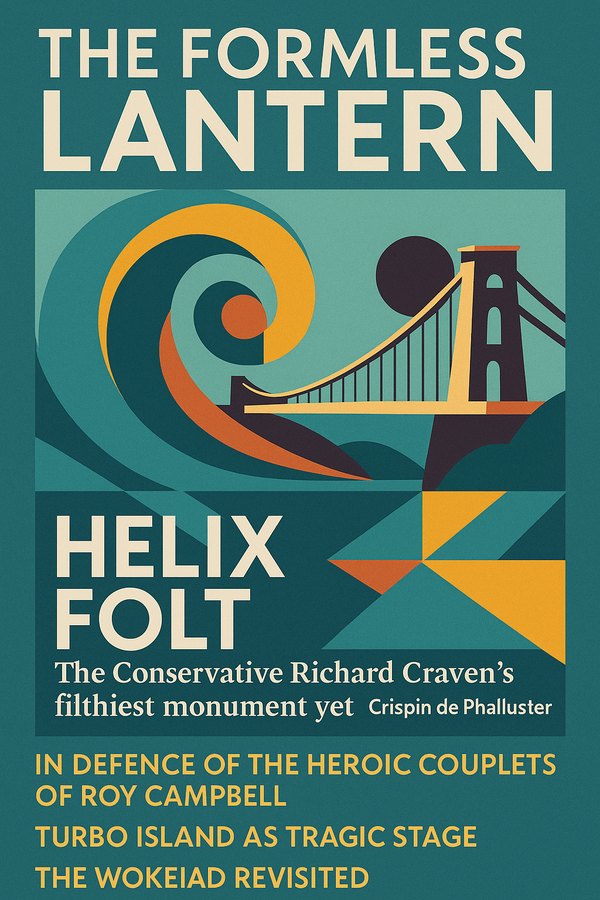
Crispin de Phalluster in The Formless Lantern
Richard Craven’s Helix Folt the Conservative is, to my mind, the most complete expression yet of his Bristolian grotesquerie. Readers familiar with his earlier works will recognise the method: the solemn appropriation of august forms, only to see them dragged through a slurry of modern absurdity. Amoeba Dick was a parody of Moby-Dick, a nautical Swift of tentacles and bilge. Pretty Poli inverted Hardy’s Mayor of Casterbridge into a grotesque fable of political and European farce. Odour Issues rewrote The Odyssey as a scatological epic, returning its hero not to Ithaca but to the jakes of modernity. With Helix Folt, Craven extends this strategy to George Eliot: he produces, with perverse fidelity, an anti-ethical novel whose genius is to turn every moral aspiration into an occasion for parody.
The protagonist, Helix Folt, is no hero. He is a naïf dutiful, earnest, fatally polite who finds himself swept into the civic carnival of Bristol, a place where public virtue is indistinguishable from graft, and every tribunal is a kangaroo court in fancy dress. Folt’s journey from bewildered innocent to humiliated emblem provides Craven with his richest canvas yet. The narrative is less a progression than an accumulation: octopus-rights campaigns, therapeutic nurseries, pub-room radicals, massage parlours masquerading as inquisitions, each piled upon the last in a grand heap of farcical indignities. To read it is to endure, alongside Folt, the slow attrition of sincerity by spectacle.
What makes this more than a freak-show is Craven’s command of parody. The cadences of Eliot’s moral narration are everywhere echoed, only to be subverted. Where Eliot asked, with deep seriousness, how we are to live well among others, Craven asks how we are to live at all amid such absurdity. His answer, if it can be called that, is merciless: there is no redemptive arc, no moral improvement, only the comedy of a man trying to swim against a tide of hypocrisy, until he is at last submerged.
The comedy is, of course, indecorous. Craven delights in the grotesque, the scatalogical, the downright offensive, and in this too he marks himself as a necessary corrective to our age of paper-thin virtue. Folt is mocked, but so too are his accusers: the bureaucrats who gorge on grants, the zealots who inflate trifles into crusades, the grandees who mistake their own cant for gravitas. Bristol itself becomes the stage on which every piety collapses into ridicule.
One cannot overlook, either, the sheer linguistic bravado. Craven’s prose is at once archaic and up-to-the-minute, peppered with mock-Chaucerian plaints, Burkean invocations, and the bar-room slang of the petty radical. The result is a polyphony of English registers, held together by an authorial voice that is by turns magisterial and gleefully puerile. It is not, perhaps, to everyone’s taste; but then, neither is Swift, nor Rabelais, nor the later Dickens. Craven demands of his readers a tolerance for filth in pursuit of truth.
Does it succeed? To my mind, yes resoundingly so. If Amoeba Dick was Craven’s announcement, Odour Issues his voyage, and Pretty Poli his provocation, then Helix Folt the Conservative is his consolidation: a novel that brings his obsessions into sharpest focus. It is not enjoyable in any conventional sense it is too abrasive, too scornful but it is indispensable, because it exposes the absurdity at the heart of our public life.
Richard Craven has once again written a book that should not be read in polite company, and yet must be read by anyone who wishes to understand the true comedy of our times. Helix Folt the Conservative may be his filthiest monument yet, and it confirms him as the indispensable parodist of our civic decay.